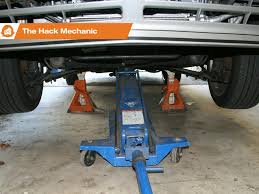
Jacks help you lift your vehicle off the ground and lower it back down. Once your vehicle is lifted, the stands hold it in the lifted position during repairs, service, and maintenance. Here are some tips to help you lift your vehicle safely using a floor jack and jack stands:
Use the Right Jack
A floor jack comes with a wide base, a lifting platform, and a horizontal cylinder with a piston. The jack uses air pressure to move the piston, which raises the platform. Before using the jack, check its lifting capacity and determine if you can use it to lift your vehicle safely. If your work involves lifting semi-tractors and tractor-trailers, choose heavy-duty or industrial jacks. The vehicle’s weight must not exceed the jack’s lifting capacity. Check the maximum lifting height because it determines how high you can lift the vehicle. Semi-tractors and trailers usually require more clearance and jacks with taller heights.
Find a Level Surface
Jacks and stands have a flat base meant to be used on flat surfaces, so check the area under the vehicle for slopes and obstructions. Any slight slope on the ground can cause your tractor to shift or roll out of position during lifting. The ground must also be sturdy and free of rocks or other obstructions that can present problems when maneuvering the jack. Before you position your jack, park the semi-truck or tractor, apply the brakes, secure the trailer, and place wheel chocks in position. Wheel chocks prevent your vehicle from rolling forward or back during lifting.
Use Designated Jacking Points
Original equipment manufacturers design designated jacking points for lifting the vehicle. Before you start lifting, check your vehicle’s manual to identify the jacking points and position your jack and stands along those points. Avoid jacking from any other point, even if it seems sturdy, to safely support the vehicle’s weight. Position the jack at the center of the jacking point, but leave enough space to place your jack stands. Jack up the vehicle slowly, checking the contacts and base for signs of movement. Observe the jack’s operation and stop immediately if you notice any faulty behavior.
Place Your Jack Stands
The jacking points usually have enough space for the jack and stands. Once you lift your vehicle to the desired height, position the jack stand directly under the lifting point. Adjust the stand’s height to allow it to slide beneath the lifting points. Release the hydraulic pressure to lower the jack’s platform. Confirm that your vehicle is tightly pressed against the stand, and watch out for any sign of shaking. You can fully lower the jack if the vehicle is secure on the stand. Jacks can hold your vehicle for a while but need to be replaced by jack stands during lengthy repairs and maintenance.
Perform a Stability Check
Before you start working on your vehicle, perform a final stability check when the tractor is safely on the jack stands. If you’re lifting on gravel, grass, or soft dirt, check the surface around the stands to see if the vehicle’s weight has impacted the ground. Take a few steps back to get a full view of the tractor and verify that the stands are at the same height and the vehicle is level. Push your vehicle lightly to verify that the contact with the stands is secure. If everything in the final stability check looks good, you can leave the vehicle on the stand.
Find a High-quality Floor Jack Today
Using jacks is easy and safe if you have the right tools and follow the correct procedures. When purchasing jacks, check the material quality, load rating, and reviews to find one that suits your vehicle. Contact a specialty tool supplier to find a high-quality floor jack for your vehicle.


